 By Ken Millbank
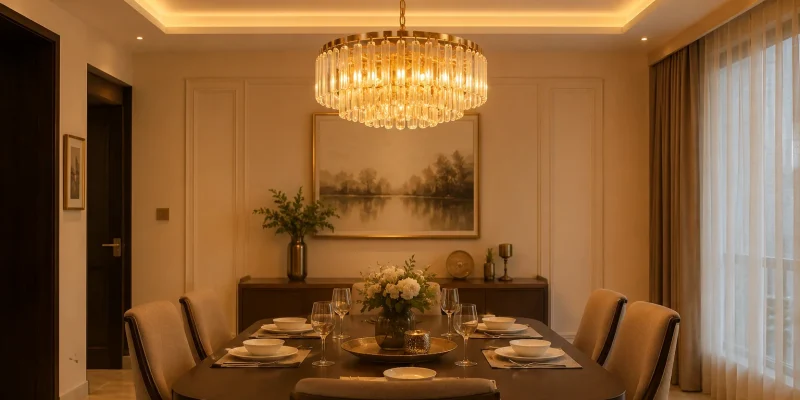
A dining room chandelier does more than illuminate dinner plates. It anchors the table visually, sets the mood for weeknight meals and holiday gatherings, and shapes how people move through the space. When a fixture is too small, it looks lost over a long expanse of wood or stone. When it hangs too low, someone standing up to clear dishes or reach across the table bumps their head or loses sight of the person sitting opposite them.
Getting the proportions right over a rectangular table takes a bit of measuring, though the underlying rules are straightforward once you know what to look for. Instead of relying on guesswork or eye-balling a showroom display, you can size and hang a fixture with confidence by working from your table dimensions, ceiling height, and fixture shape.
Measuring for Width and Length Over a Rectangular Table
Rectangular tables create a unique geometry challenge compared to round or square tables. A round fixture can easily look stubby stretched over an eight-foot table, while an oversized linear piece can crowd a compact breakfast or dining nook.
Using the Table Width Rule for Round and Tiered Fixtures
When choosing a traditional round, drum, or tiered chandelier, start by measuring the width of your dining table from side to side. A reliable baseline is to select a fixture whose diameter is roughly one-half to two-thirds of the table width. If your table is 42 inches wide, a chandelier between 21 and 28 inches across will usually feel balanced without extending past the edges where people walk.
Keep a comfortable buffer between the outer edge of the chandelier and the outer edge of the tabletop. Leaving at least 6 to 12 inches of clearance on each side helps prevent accidental bumps and keeps the visual weight centered over the dining surface rather than floating over empty floor space.
Sizing Linear Chandeliers and Multi-Light Bars
For most rectangular dining tables, elongated fixtures such as linear chandeliers, rectangular lanterns, or horizontal multi-pendant bars fit the footprint better than a single compact sphere. Instead of matching table width alone, measure the length of the table and aim for a fixture length that spans about one-half to two-thirds of that length.
On a 72-inch (six-foot) table, a linear fixture roughly 36 to 48 inches long distributes light evenly from one end to the other. On an 84- or 96-inch table, a 48- to 60-inch fixture prevents dark pockets at the ends while still leaving breathing room for serving platters, wine decanters, and centerpieces.
Checking Room Scale So the Fixture Does Not Overwhelm
Table measurements tell half the story, and room size tells the other half. Even a mathematically correct table ratio can feel heavy if the dining room itself is tight or enclosed by tall cabinetry and sideboards.
A quick room-size check helps keep proportions honest. Add the length and width of the dining room in feet, and convert that sum into inches for a rough maximum diameter on a classic round chandelier. For example, a 12-by-14-foot room equals 26, pointing toward a fixture around 26 inches wide. Treat this number as a ceiling rather than a strict rule, especially in open-concept floor plans where the dining area shares volume with a kitchen or living room.
Setting the Right Hanging Height Above the Tabletop
Hanging height governs both comfort and sightlines. If a chandelier hangs too high, the light disperses thinly and the fixture feels disconnected from the table; if it hangs too low, glare enters diners’ eyes and conversation across the table becomes awkward.
Standard Clearance for 8-Foot Ceilings
In a standard dining room with 8-foot (96-inch) ceilings, the bottom of the chandelier typically sits 30 to 36 inches above the top of the dining table. That range keeps warm task light focused on the food and table surface while leaving plenty of open air above seated guests.
Because 36 inches of clearance on an 8-foot ceiling leaves only about 24 to 30 inches between the ceiling canopy and the top of the fixture, compact semi-flush mounts, low-profile linear lights, or fixtures with shorter stems work best here. Long chain drops often crowd lower ceilings and visually shrink the room.
Adjusting Height for Tall, Vaulted, or Tray Ceilings
When ceilings rise to 9, 10, or more feet, you can usually hang the fixture slightly higher to honor the vertical volume of the room without losing intimacy over the table. A helpful rule of thumb is to add about 3 inches of height above the table for every extra foot of ceiling height above 8 feet, generally keeping the bottom of the fixture within 30 to 42 inches above the tabletop in typical residential dining spaces.
In rooms with vaulted ceilings or steep angles, pay close attention to downrod or chain lengths and slope adapters. Make sure the chandelier sits in visual relationship with the table rather than vanishing near the ridge of the ceiling, unless the architecture calls for a dramatic sculptural statement.
Sightlines, Glare, and Standing Clearance
Before locking in a chain or rod length, think about how your household uses the room. If people frequently stand up to grab drinks from a credenza, pass serving bowls, or clear plates during dinner parties, err toward the 34- to 36-inch mark above the table rather than hugging the lower end.
Eye level is another practical check. Sit in a dining chair and look across the table toward the person sitting opposite you. If exposed bulbs or bright filament tips sit directly in your line of sight, raise the fixture slightly or choose shades, diffusers, or frosted glass that shield bare bulbs from side angles.
Choosing a Fixture Style That Matches Rectangular Proportions
Shape and transparency change how large a chandelier feels. Two fixtures with the exact same width or length can read completely differently depending on whether they are solid metal, open cage frames, or layered crystal.
Open Frames Versus Solid or Heavy Shades
An open geometric lantern or thin linear frame lets light and sight pass through, making a wider fixture look lighter in the room. By contrast, a solid opaque drum, heavy wrought-iron body, or dense cluster of glass globes carries stronger visual mass and can feel imposing if pushed to the top of the size range.
If you are torn between two sizes over a rectangular table, size down for heavy, dark, or opaque fixtures and size up slightly for airy, open-work designs. That adjustment keeps the room feeling balanced and uncluttered.
Lighting Output and Dimmer Control
Proportion is not purely physical; brightness also shapes how a fixture feels over a rectangular table. A long table benefits from even illumination across its length, whether from multiple sockets along a linear bar, a multi-bulb cluster, or integrated LEDs with high color rendering so food and wood tones look natural.
Always pair a dining chandelier with a compatible dimmer switch. Bright overhead light works well for homework, crafts, or setting the table, while a lower setting softens shadows for evening meals and casual gatherings.
Step-by-Step Sizing Walkthrough Before You Buy
Walking through a few concrete measurements before ordering saves time, return shipping, and electrical rework. Measure the table length and width with a tape measure, note the ceiling height, and check where the existing junction box sits relative to the center of the table.
If the ceiling box is off-center because the table was moved or resized, you do not always have to rewire the ceiling immediately. Swag hooks, ceiling tracks, or linear fixtures with adjustable suspension points can help realign the light over the center of the table while keeping installation clean.
For a quick mental check on a classic rectangular setup, picture a 7-foot (84-inch) table that is 40 inches wide under a 9-foot ceiling. A linear chandelier around 48 to 54 inches long—or a round fixture near 24 to 26 inches wide—hung roughly 33 to 36 inches above the tabletop will typically hit the sweet spot between generous illumination, clear sightlines, and comfortable movement around the room.
What is your reaction?
Excited
0
Happy
0
In Love
0
Not Sure
0
Silly
0